
If you’re thinking that whether should I self publish my book or take the traditional route, you need to evaluate both the options very carefully. Each path has its own advantages and challenges, and the right choice depends on your goals, resources, and preferences.
With traditional publishing, a publishing house takes over your book’s rights and handles the entire process—from editing to marketing—while you receive a share of the royalties. Self-publishing, on the other hand, allows you to retain full rights and earnings but requires you to manage everything yourself, from formatting to sales.
So, should you self-publish your book or go the traditional route? In this guide, we’ll break down the pros and cons of self-publishing vs. traditional publishing to help you make an informed decision.
Self-publishing has experienced a significant boom in recent years, making it easier than ever for authors to get their work into readers’ hands. But is it the best choice for you? Here’s a quick breakdown of the differences between self-publishing and traditional publishing:
| You should self-publish if you… | You should traditionally publish if you… |
|---|---|
| Can handle editing, marketing, and design yourself (or hire freelancers). | Prefer a team of professionals to handle production and marketing. |
| Want full creative control over your book. | Are okay with publishers making changes to your manuscript. |
| Prefer higher royalty rates (35%-70% on ebooks, 40%-60% on print). | Prefer an advance payment ($5k-$10k) and lower royalties (5%-25%). |
| Want to retain all rights to your book. | Can accept possibly giving up subsidiary and foreign rights. |
| Want to ensure your book gets published. | Are willing to face multiple rejections from agents and publishers. |
| Want to choose your own publication date. | Can wait for a publisher to schedule your book. |
| Have some funds to invest in publishing and marketing. | Prefer not to invest your own money upfront. |
| Plan to sell primarily online (Amazon, Kobo, etc.). | Want your book in physical bookstores. |
| Don’t have a huge following yet. | Are a celebrity or influencer with a built-in audience. |
| Don’t care about literary prizes or traditional recognition. | Want your book to be eligible for prestigious literary awards. |
Now that you have a basic idea, let’s take a closer look at why you might want to self-publish your book.
When you traditionally publish, your manuscript will go through multiple revisions guided by agents, editors, and marketing teams. You might have to compromise on certain elements, such as the book cover, title, or even the plot.
With self-publishing, you make all the final decisions. You get to choose the cover design, the formatting, and the overall presentation of your book. While it’s always good to hire professional editors and designers, you have the final say in everything.
Traditional publishing involves submitting your manuscript to agents and publishers, facing countless rejections, and waiting for months (or years) before you even get a contract. Some genres, like poetry or short story collections, are notoriously difficult to publish traditionally.
Self-publishing eliminates that frustration. You don’t need anyone’s approval to publish your book—you can do it on Amazon KDP, Apple Books, Kobo, and other platforms whenever you’re ready.
Traditional publishing can take 1-2 years from contract signing to book release due to long editing, marketing, and production schedules.
With self-publishing, you set your own timeline. If you work efficiently with your editors and designers, you could publish your book in just a few months.
Traditional publishers typically offer authors 5%-25% royalties, depending on the format. While they might give you an advance payment, they also take a large share of the earnings.
In contrast, self-publishing platforms allow you to keep a much bigger percentage:
If your book sells well, self-publishing can be far more profitable.
When you traditionally publish, you often sign away rights to:
With self-publishing, you control these rights and can negotiate your own deals if opportunities arise. This means more potential revenue streams in the long run.
If you’ve decided to go the self-publishing route, the next question is: where should you publish? Here are the top platforms:
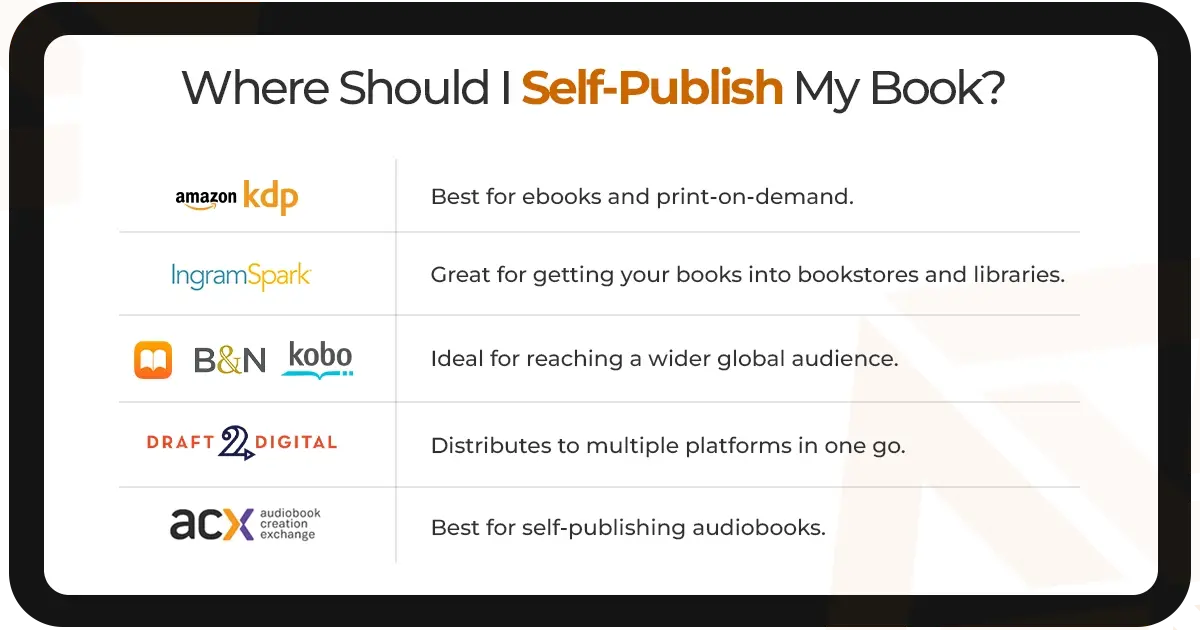
Each platform has its pros and cons, so choose based on your goals and target audience.
There’s no one-size-fits-all answer. If you want full control, faster publishing, and higher royalties, then self-publishing is your best bet. But if you prefer structured support, prestige, and bookstore distribution, traditional publishing might be the way to go.
At the end of the day, the best publishing path is the one that aligns with your goals, skills, and vision. Whether you choose to self-publish or go traditional, the most important thing is to get your book out into the world!