If you’re wondering, should I self-publish on IngramSpark or Amazon? you’re not alone. Many authors ask this question, and the answer isn’t always simple. Both platforms offer unique advantages and challenges, making it crucial to understand their differences before making a decision.
After over a decade of experience helping authors self-publish without looking self-published, we’ve developed a strategy that utilizes both Amazon KDP and IngramSpark for maximum benefit. Below, we break down the pros and cons of each platform to help you decide which works best for your book.
| Feature | Amazon KDP | IngramSpark |
|---|---|---|
| Ease of Use | Simple and user-friendly | More complex with a steeper learning curve |
| Customer Support | Quick response via chat, email, or call | Slow response, email-only support |
| Bookstore & Library Access | Limited—most bookstores don’t buy from Amazon | Books are listed in Ingram’s catalog, making them more accessible to bookstores and libraries |
| Hardcover Options | No dust jackets, limited customization | Allows dust jackets and better-quality printing |
| Print Costs | Lower printing costs | Higher printing and handling fees |
| Amazon Compatibility | Direct publishing ensures smooth sales and fulfillment | Amazon often lists IngramSpark books as “out of stock” or delays shipping |
| Distribution | Primarily Amazon and Kindle | Wider distribution to bookstores, libraries, and retailers |
| Royalties & Fees | No upfront fees, higher royalties | Setup and revision fees, lower royalties due to higher costs |
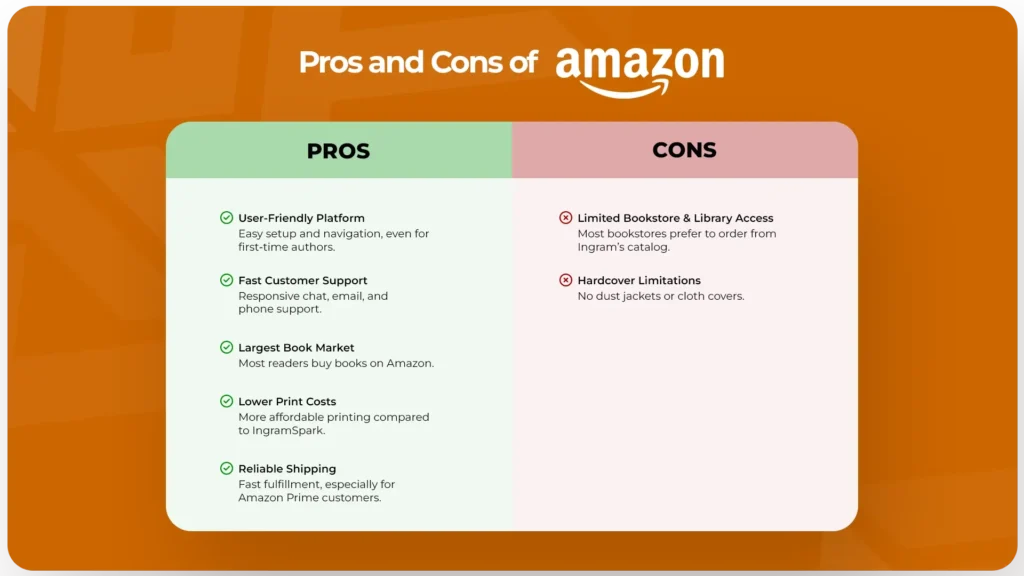
Pros:
Cons:

Pros:
Cons:
Rather than choosing between Amazon KDP and IngramSpark, why not leverage both? Here’s how we suggest using them together:
By strategically using both platforms, you can maximize your book’s reach while avoiding common pitfalls. Whether you prioritize ease of use, bookstore access, or hardcover options, this approach gives you the best of both worlds.
So, should you self-publish on IngramSpark or Amazon? The best answer is: why not both?